What Are the Two Types of Uploaded Ads?
I'1000 going to get out on a limb hither. You want people to get your customers, correct?
Of course you practise. You've got bills to pay, mouths to feed, erstwhile paramours to impress. Well, partner, yous've come to the right place. Though I won't be so bold as to claim that using Google display ads is essential, I will be and so bold as to claim that it's a actually practiced investment. And about i in 4 of you still seem to need more than convincing!

What's so bully about Google display advertising? Well, it helps yous do 2 things that are crucial to winning new customers:
- Building a valuable, recognizable brand, and
- Keeping that brand at the acme of your prospects' minds.
Audio adept? Awesome. Let'southward go into it, and then.
By the cease of this Google brandish advertizement crook sheet, you'll know a whole lot more about:
- The value of brandish advertising
- Google display ad specs (including display ad types and sizes)
- Google brandish ad costs
- Google display targeting parameters
- How to prepare upwardly Google display ads
Permit's get into it!
Note: For display advertising tips during the pandemic, check out this post: 4 Tips for Better Brandish Advertising During COVID-19.
What is a Google display ad?
Although the term "display ad" may be unfamiliar, y'all're almost certainly familiar with brandish ads themselves. They're the visual-based ads you see while reading an commodity on your favorite blog, watching a video on YouTube, or using a mobile app.

Appropriately, Google display ads are served on the Google Display Network—a network of over two million websites and apps that reaches somewhere in the ballpark of 90% of net users. Such an immense potential for achieve is the definition of a double-edged sword. Truthful—you lot have the power to introduce your brand to tons of relevant consumers. Only you lot're as well liable to introduce your brand to tons of irrelevant consumers.
In other words: Brandish ads can toll you lot a bunch of money if you're not careful. Nosotros'll talk most the steps you can take to avert waste subsequently in this postal service.
The case for display ads
Earlier nosotros dive into the details of display advertising, let'south take a bird's-eye view. The other major Google Ads network is the Search Network, which enables advertisers to buy promotional real estate in the Google search results. Generally, search ad is a valuable channel for marketers because it allows them to capitalize on the commercial intent that oft motivates people to use Google.
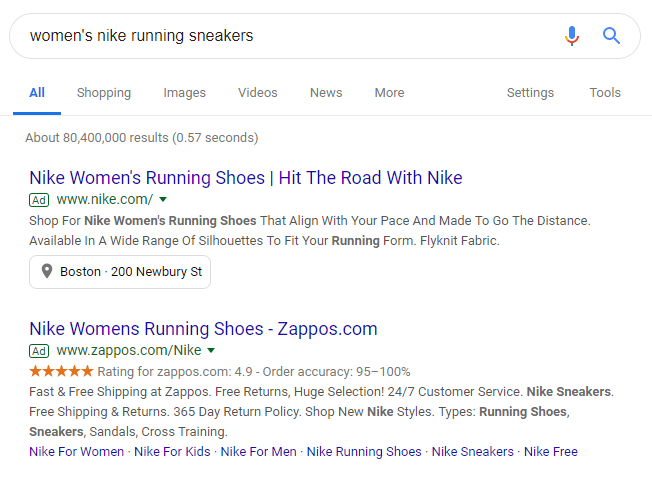
The same can't be said for display advertising. People are served display ads while they're consuming content—not while they're actively looking for solutions, as is the case on the search network. Put differently, the commercial intent that makes search advertising and so valuable doesn't exist on the display network.
So, why bother with display ads? Unlike marketers respond this question differently, but we're pretty confident in that location are a couple reasons nearly everyone can agree on.
Want to create designer-quality display ads in minutes? Attempt our free Smart Ads Creator.
The starting time involves branding. Because you lot and your competitors are going afterwards the same prospects, y'all have to find ways to differentiate yourself—to separate your business from the pack. Thanks to the power of visual imagery, brandish advertising is an opportunity to constitute (and distinguish) your brand in your prospects' minds.
The 2d is more than practical. Typically, a prospect won't become your client immediately after seeing your product or service advertised on the search network for the first time. Even if they click on your advertising, they'll near probable go out your website without taking any form of action and move onto a completely unlike task. The claiming, then, becomes getting them back on your website. With brandish ads, you can keep your business organization at the peak of your prospects' minds.
Alrighty, and so! With the high-level stuff out of the style, nosotros can get into the details.
Google display ad types
Broadly speaking, at that place are two types of Google display ads: uploaded and responsive. Whereas uploaded ads place the onus of creation and optimization (more on this below) entirely on you, responsive ads pass the reins to Google Ads.

If yous have the design resource to create your own brandish ads from scratch, then by all means—take the uploaded route. JPG, PNG, and GIF files are all supported. Keep in listen, even so, that every web page is dissimilar. Even if you lot qualify for a detail placement, your advert won't exist shown if information technology doesn't encounter the size specifications for the folio. This is what we mean when nosotros say uploaded brandish ads place the onus of optimization on yous—yous accept to create differently sized versions of each advertizement.
Because that'due south not the well-nigh fun activity, Google introduced responsive display ads a couple years ago. In fact, as of the summer of 2018, the responsive ad type is the default for display advertisers. The process couldn't be much easier. Simply upload your business concern' proper name and logo along with some visual avails (images and videos) and some bones ad copy. From in that location, Google Ads volition test different combinations of visuals and copy to decide which versions of your ad perform well. Best of all, responsive display ads automatically adapt in size to meet the requirements of specific spider web pages.
If you're looking for a couple more than options, we'll discuss three of our favorite advertizing creation tools (all free!) at the terminate of the guide.
Google display ad sizes
If you're planning on running only responsive display ads, you can go ahead and skip to the next department. Alternatively, if you'd like to maintain control over your ads and you program on taking the uploaded route, these are 12 common sizes you'll likely need to accommodate:
- Mobile: 300×250, 320×l, 320×100, 250×250, 200×200
- Desktop: 300×250, 336×280, 728×90, 300×600, 160×600, 970×90, 468×60
Google display advertising costs
Similar the Google search network, the Google display network runs on a live auction system. When you're eligible for a given advertisement unit—according to your targeting parameters—you're entered into an instantaneous auction with the other advertisers who are eligible for that same unit. For the sake of simplicity, let's assume you and your competitors are bidding on a cost per click (CPC) basis and competing for real manor on a standard blog page.
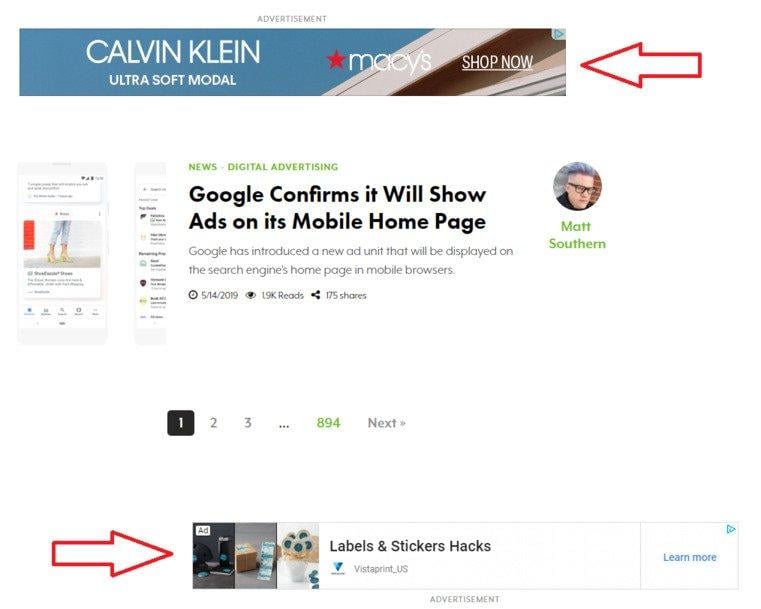
The auction is Google'southward mode of determining where each advertiser lands on the page and how much each advertiser pays for a click. Your ad position and CPC depend on your Advertisement Rank—a metric that, in turn, depends on your maximum CPC bid and Quality Score. The sometime, of grade, is the maximum corporeality of money yous're willing to pay for a click on your ad. The latter is basically a measure of how relevant your ad is to the people yous're targeting.
The outcome of the auction determines how much yous actually pay for a click—your bodily CPC. Often, this is lower than your maximum CPC bid. When all is said and done, you lot pay the minimum corporeality of coin required to outrank the advertiser in the position directly below yours—for incremental clicks, that is.
An incremental click is a click yous wouldn't take gotten if you were in a lower advertising position. For case, while the advertisement in the first position may get five clicks, the ad in the second position may merely get three clicks. In this case, two of the top ad's five clicks are considered incremental. The CPC for those two clicks is just high enough to outrank the next advertiser. Nonetheless, the CPC for the remaining three clicks is equal to what the adjacent advertiser is paying for their clicks.
So, even if you win the all-time ad position on the page, a lot of the clicks yous drive will be priced every bit if you're in a lower position. The clicks y'all bulldoze solely because your ad is more than visible are slightly more expensive.
According to WordStream data, the average CPC on the Google display network is $0.63. For comparison, the average CPC on the search network is $2.69—more than than four times greater. That's because search network clicks are generally more valuable, as we discussed earlier.

Google brandish advert targeting
Equally promised before, the time has come to talk about the steps you can take to avoid wasting your display advertising budget. Broadly, the key to efficiently spending your display budget is layering your targeting parameters to yield the most relevant impressions and clicks possible.
This raises the question: What targeting parameters do yous take at your disposal? At the advertizement group level, there are two categories of targeting parameters: people and context. Whereas the former category enables y'all to advertise to specific groups of people, the latter enables yous to advertise within certain types of content. Let's look at each in turn.
People targeting for display ads
In that location are two subcategories beneath the umbrella of people targeting: demographics and audiences. With demographic targeting, you can serve your ads to sure groups of people based on characteristics like historic period, gender, and parental status. Audition targeting, on the other hand, is based on interests and behaviors. Believe it or non, this branches off into a few more subcategories.
An affinity audience is but a broad group of people who share a common interest. Sports fans, travelers, and foodies are all examples of affinity audiences you can target with your display ads. If you find that Google Ads' pre-fabricated options are too general, you tin create your ain custom analogousness audiences. (Note: Custom intent and custom affinity audiences take been combined and are now just referred to every bit custom audiences.

An in-market audition is a group of people who are actively looking to purchase a particular product or service. These audiences are powerful, of course, because they enable you to keep your business at the summit of the minds of consumers near the bottom of the funnel.
A remarketing audition, finally, is a grouping of people who have interacted with your business in some mode—often by visiting your website. As nosotros said before, a key function of the case for display advertising is the ability to re-engage your prospects.
Contextual targeting for brandish ads
Equally with people targeting, contextual targeting comes with two subcategories: keywords and topics. With keyword targeting, you can serve your display ads within pieces of content that chronicle to a particular keyword. For example, if yous're advertising running gear, you can target keywords similar "running sneakers" and "running wristwatch."
Topic targeting, on the other mitt, enables you to serve your display ads inside pieces of content that pertain to a item topic. For example, if y'all're advertizement an upcoming music festival, you tin can target topics like "music" and "live entertainment."

Maybe more importantly, Google Ads allows you to exclude specific topics as well. Topic exclusions are meant to keep your brand away from irrelevant or inappropriate content. If you were ad a violent video game, for example, yous'd probably desire to go along your brandish ads off websites that publish educational content for young kids.
For more than swell display ad examples, check out these 17 display ads that stuck out to us in 2020.
How to ready up a Google display advertizing campaign
5 Google display ad best practices
Alrighty so! Now that nosotros've covered all the technical details of display advertising, allow's talk about some of the best practices you can implement to maximize your returns.
1. Tap into your superlative-performing search keywords
Keyword targeting is a great style to introduce your business to relevant audiences. If you'd like to give it a effort but you're unsure of where to start, nosotros recommend using your top-performing search keywords at the offset. The definition of "top-performing" is upward to yous, of class, but if there'south a handful of keywords that tend to drive low-cost clicks or conversions on the search network, why not requite them a shot on the display network?
True—consumer intent on the 2 networks is completely different. Only insofar as clicks and conversions indicate that your search ads are resonating, you tin feel confident that the keywords behind them are winners.
ii. Utilize bid adjustments
After running your display campaigns for a while, you'll accept enough information to make informed performance judgements—which keywords are doing well, which custom affinity audiences are doing poorly, and and so on. Bid adjustments—which you can set at either the advertising group or campaign level—allow you to plow those performance judgements into strategy.
When you set a positive bid aligning on a given ad grouping, you lot tell Google Ads to increase your maximum CPC bid whenever i of the ads in that ad group is eligible to bear witness. Also, when you set a negative bid adjustment, yous tell Google Ads to decrease your maximum CPC bids for that ad group.
Plainly and simple, using bid adjustments is a terrific way to heave your gains from top performers and cut your losses from poor performers.
3. Wait at your referral traffic
Google Analytics is full of useful information. For display advertisers, the referral traffic study (which lives under Acquisition > All Traffic) is incredibly valuable. Basically, the referral traffic report tells y'all which websites are linking to yours the well-nigh. Put differently, it tells you which websites cater to people that could benefit from your production or service.
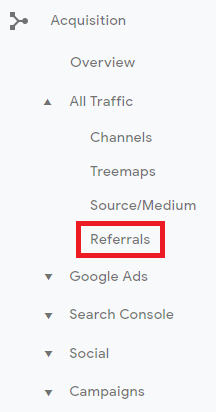
These websites brand for the perfect places to serve your display ads. Because you know you're advertizement to relevant audiences, you can feel confident that you're driving returns on those impressions and clicks.
4. Emphasize your value proposition
Because they're beyond accustomed to display advertizement at this bespeak, your prospects can very easily curl by your ads without even noticing them. To avoid wasting opportunities—also equally money if you're bidding on a price per thousand impressions (CPM) footing—information technology'due south crucial that your display ads grab your prospects' attention.

Obviously, the visual aesthetics of your ads—colour scheme, typography, etc.—play a huge role in this. What'southward less obvious is the role your value suggestion plays. Your value proposition, quite simply, is the benefit someone will savour upon condign your customer. If you're ad a pair of men's boots, for example, your value proposition might exist the enhanced conviction 1 feels when he looks skilful.
No matter what your value suggestion is, arrive jump off the page.
5. Focus on headlines when writing RSAs
When creating a responsive display ad, you'll be prompted to write four pieces of copy:
- A short headline (25 characters)
- A long headline (90 characters)
- A clarification (xc characters)
- Your business concern proper name (25 characters)
Regarding headlines, there are two primal things you need to know: (i) Google Ads volition never run both at the same time; (2) Google Ads will sometimes exclude your clarification. Regardless of which headline is selected for a particular iteration of your RSA, at that place'southward no guarantee it'll exist accompanied by your description.
The takeaway: Make sure your headlines are plenty on their own. Both should communicate the unique value of your business or the offering you're making.
5 crawly Google display advertisement examples
No cheat sheet is complete without a little inspiration! Let's wrap up this guide with five examples of crawly Google brandish ads. We'll make sure to intermission down what makes them tick so you can walk away with immediately actionable tips.
1. CheapCaribbean.com uses stellar imagery
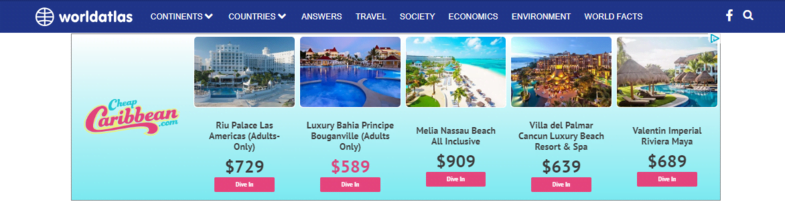
Our first example is courtesy of CheapCaribbean.com—a travel agency that helps people volume vacations in the Caribbean. I came across this beaut while perusing a travel web log and felt immediately impressed by its effectiveness. First things first—the images are beyond gorgeous. Assuming the goal of this ad is to incentivize me to go back on Google and continue searching for a luxurious Caribbean destination, I'd say it's a home run.
Additionally, the visitor makes fantastic employ of the ad re-create. By highlighting the affordable prices of their offerings, they're sending a strong message: When we say cheap, we mean it.
2. ClickCease taps into the power of fear

ClickCease—a software visitor that helps advertisers mitigate click fraud—served me this display ad while I was reading a Search Engine Journal article. What makes it then effective is the use of fear to both catch my attending and communicate the value of the product they're selling. Fear is an arresting, persuasive emotion. Because no PPC marketer wants to autumn victim to click fraud, this is an ad that's certain to get out an impression.
1 small critique: This advertizement needs a brand name. Although it'south constructive, it's not as trustworthy as it needs to be to meet its full potential.
iii. Wikibuy makes an undeniable value suggestion
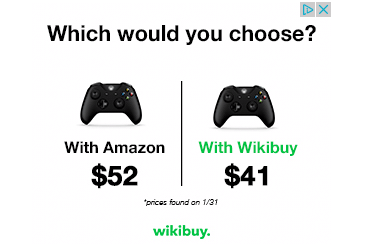
Allow's get competitive! Wikibuy—an online shopping banana that automatically hunts for the best deals available to you—hit me with this wonderful lilliputian display ad while I was perusing the news. The central to its forcefulness? Simplicity. That right there is a expressionless-simple advertizement with a dead-simple value proposition: Stuff is cheaper when you buy it from the states. The copy is minimal, nevertheless it jumps off the screen. The make proper noun is there, merely it takes a back-seat to the value prop. Those of you in highly competitive markets should have notes!
4. Alteryx nails it with their headline (and their offer)

In that location's a LOT that I like about this display ad from Alteryx—a software solution for data science and analytics. Outset of all, that's a hell of a headline. Injecting a piffling aspirational sentiment into your ad copy never hurt anybody. Secondly, the subhead puts forth a cracking value suggestion: Nosotros make analyzing data like shooting fish in a barrel. I think that'south something all marketers can go on lath with. And finally, the company hit the nail on the head with their offer—an ebook. Rather than trying to take my coin right abroad, they're but trying to become me in their funnel.
5. LinkedIn makes it personal

We'll wrap up our Google display ads crook sail with this 1 from LinkedIn. If at that place'due south i thing that makes this ad great, it's the personalization. Because I'thousand a B2B marketer, this ad instantaneously grabbed my attention when I saw information technology on the homepage of EZgif (an essential tool for all my fellow content marketers). Beyond that, LinkedIn is doing the same thing as ClickCease—creating fear. More than specifically, they're creating a fear of missing out (FOMO). Because no marketer wants to exist a tardily adopter, this is a super clickable advert.
three easy, gratuitous tools for creating Google brandish ads
As much as we dear display advertising, we've noticed a glaring problem with it: it's not as accessible equally it is powerful. A lot of small and medium-sized businesses merely don't accept the resources—fourth dimension, money, designers—to create sleek, effective brandish ads.
Fortunately, there are a number of free tools on the market that enable you to easily create your own Google display ads. Here are three of our personal favorites:
- Smart Ads Creator: Simply enter a website or page URL and nosotros'll turn your best visual assets into cute brandish ads in a matter of minutes.
- Bannersnack: Drag-and-drib all kinds of free fonts, stock photos, and animations to create high-quality visuals that work across platforms.
- Canva: Browse thousands of free, flexible banner ad templates and customize them to friction match your brand aesthetic.
Source: https://www.wordstream.com/blog/ws/2019/05/23/google-display-ads
0 Response to "What Are the Two Types of Uploaded Ads?"
Post a Comment